Data protection in processes
Ormuz associates data flowing through a process with a protection class: normal , sensitive or secret . This classification follows the data when it is bound to a node, transformed, placed in a variable, sent to a subprocess, or returned as a result. It limits accidental exposure without preventing intentional business use.
The three classes
Classification belongs to the data itself, not to the node manipulating it. The same node can therefore receive a field
normal and a field secret simultaneously without its entire context becoming uniformly secret.
| Classe | Meaning | Examples | Generic visibility |
|---|---|---|---|
normal | Business data without additional protection imposed by the process model. | Status, public label, non-confidential business identifier. | Normally visible in execution surfaces the user can access. |
sensitive | Business data whose use may be legitimate but whose raw value should not be displayed by default in generic observability surfaces. | Bank details or personal data when explicitly classified that way. | Masked by default in history and generic views. |
secret | Credential or value that must not be exposed through generic surfaces and must not be saved as a constant in a process definition. | Password, access token, code, or temporary credential. | Protected and masked; it remains usable by nodes to which the process intentionally passes it. |
sensitive and secret do not mean “forbidden to use”. They mean the value receives additional protection when crossing generic platform surfaces.
Where classification comes from
A classification may be carried directly by a field contract or inherited from the data from which that field derives.
Explicit declaration. An input, output, or Form field may declare a protection class.
Semantic type. Some types carry native protection. For example,
common.passwordis always treated assecret.Inheritance. Derived data without an explicit classification keeps the class of the source from which it comes.
Absence of a declaration on derived data therefore does not automatically mean normal. It means “keep the source data's protection”.
For a custom Form field, classification is part of the field definition. For example:
{
"key": "temporary_password",
"label": "Mot de passe temporaire",
"value_type": { "type": "string", "subtype": "common.password" },
"control": "password",
"security": { "class": "secret" }
}
How it propagates
The bindings and expressions pass values between steps. The protection class travels with the value.
Binding direct
input.password [secret]
      ↓ binding
param.password [secret]
The parameter receives the same class as the source path. This also applies to a node output or process variable.
Template or expression
A composed value inherits the most protective class among the protected data it actually depends on.
"Continue: {{ nodes.link.url }}"
                   ↑ secret

template result → secret
Field-level granularity
Protection may apply to one precise field without making the entire object equivalent. For example:
company.legal_name          → normal
company.bank_account.iban   → sensitive
This granularity is also preserved in collections when the contract can identify the relevant fields.
Output without an explicit class
When a node produces an output without explicitly assigning it a more precise class, the output inherits the protection of protected data on which it depends. This prevents a generic transformation from silently removing source sensitivity.
Reduce a classification
Some nodes guarantee that a transformation produces data less sensitive than its input. For example, a node may turn a full bank identifier into its last four characters:
iban [sensitive]
    ↓ transformation
iban_last4 [declared normal]
Ormuz calls this change a classification downgrade. When a process configures such a path, the editor requests explicit consent before saving. Consent is tied to the node, the mapping concerned, and the output contract; a significant wiring change requires new consent.
A node permission authorizes an integration node to access a business object not visible in its wiring. A classification downgrade instead acknowledges that data already sent to the node intentionally leaves it with a less restrictive class.
Consent does not attempt to prove that the business transformation is correct: the designer remains responsible for choosing the transformation and wiring. It does prevent a reduction in protection from being introduced silently.
A write to durable storage declared normal follows the same rule. For example, Set metadata treats every key as a declassification boundary: writing an IBAN sensitive, or a value whose subtype imposes more restrictive Agent access, triggers consent tied to that key and mapping. Changing the source or mapping invalidates that consent. After the consented write, the stored value is normal metadata; it does not automatically re-propagate its source classification.
Inputs and Forms
Protection begins as soon as data enters the process. The main boundaries are:
- inputs supplied when launching a process;
- typed data received from an event;
- values entered in a Form or user action.
When a Form field is classified secret, the submitted value keeps this class when it becomes a node output and when used in subsequent steps. A sensitive field follows the same classification-continuity rule.
Secret constants cannot be saved directly in the process definition. A secret must come from a protected source intended for that use — for example a protected input, integration configuration, or data produced during execution.
Agents and disclosure
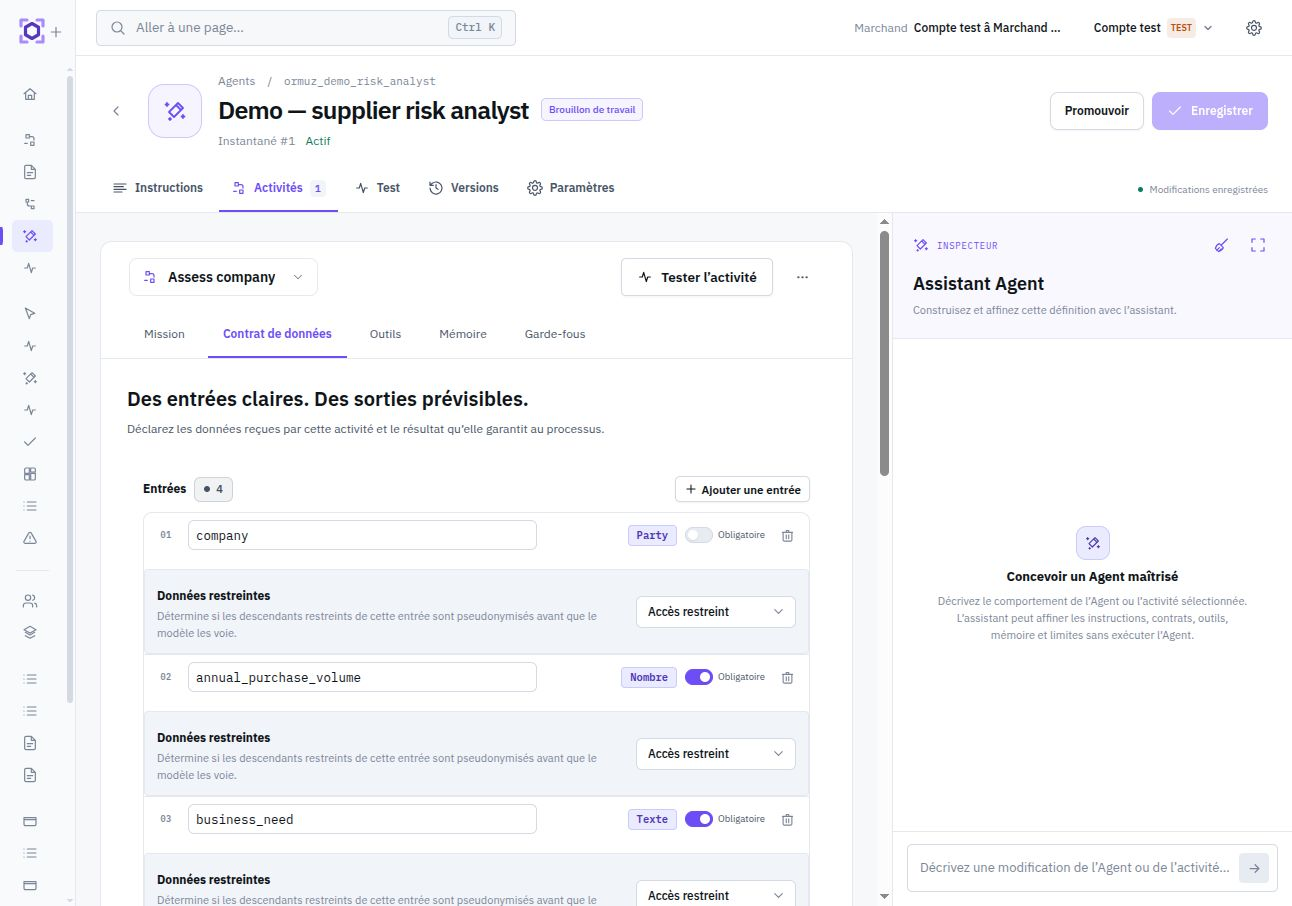
An Agent receives protected data through the explicit contract of the invoked activity. For each relevant input, disclosure policy determines whether the Agent receives a controlled projection or the raw value in raw mode when that exposure is authorized.
Classification follows the data to the Agent; history remains masked and reveal remains a separate targeted action.
Mapping data into an Agent task does not grant the Agent additional platform rights. Adding a tool to an activity also does not automatically authorize raw exposure of protected data. Disclosure consents remain evaluated separately.
The same logic applies to tool results. An activity may receive a safe projection by default and access a raw representation only when the tool contract and applicable consents allow it.
For the authority boundary, see Activities, tools, and authority. For process wiring, see Use an Agent in a process.
History and visibility
Generic observability surfaces do not directly display values classified as sensitive or secret. They indicate that protected data is present and its class without making the raw value visible by default.
This protection notably applies to:
- instance inputs;
- inputs and outputs visible in the execution chronology;
- process variables;
- user-action responses;
- process outputs.
The same rule applies to the corresponding generic APIs. A masked value in history is not functionally unavailable: a node explicitly receiving it can use it for the intended operation.
See Observability for instance and chronology monitoring.
Controlled reveal
When a persisted protected value must be inspected for diagnosis, Ormuz provides targeted reveal from observability surfaces. The user selects one precise masked value, provides the requested reason, then views it in a temporary dedicated window. There is never a global “show all sensitive data” mode.
A reveal is:
- limited to the requested value;
- subject to the specific required right;
- audited with its author, context, and reason;
- shown temporarily without turning masked history into a permanent unmasked view.
Closing the reveal window returns the user to the masked view. Investigating another protected value requires a new targeted action.
Some highly ephemeral values are never retained once their use is complete. This is notably expected for one-time codes when no retention is required. In that case, later reveal is impossible: history retains only information useful to understand that the operation occurred.
Retry, fork, and subworkflows
Classification is part of the data context and does not disappear when a process crosses an execution boundary.
Subworkflow. An input passed to a subprocess keeps its class even when the subprocess schema does not explicitly redeclare it. An explicit declaration in the subprocess nevertheless remains its own contract.
Retry. A retry preserves protections associated with input data carried over from the original instance.
Fork. Data carried over at a fork point keeps its protection classes; a fork does not turn protected data into normal data simply because a new instance is created.
Designer responsibility
The protection model limits accidental exposure and makes explicit classification changes visible. It does not replace functional process design.
It is perfectly legitimate to pass secret data to a node that must use it: a token may be required for an external call, a temporary password for a precise action, or a protected identifier for a provider. Ormuz does not block this intentional egress merely because data is secret.
The designer therefore remains responsible for recipients and business uses. The platform guarantees that classification follows the data, generic surfaces respect that protection, and an explicit reduction in classification is not silent.